Friday, October 9, 2009

Holyoke chief tries to lead chorus against the court


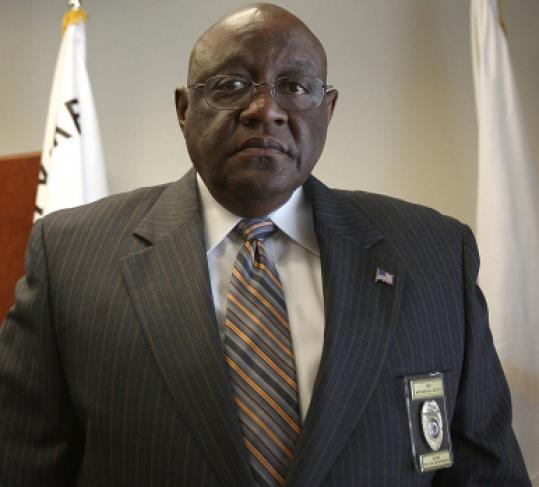
Chief Anthony R. Scott took to the radio over a recent case.Chief Anthony R. Scott took to the radio over a recent case. (Suzanne Kreiter/Globe Staff)
By Sarah Schweitzer
Globe Staff / July 10, 2009

HOLYOKE - Seven years ago, Julius Taylor was arrested on drug possession charges, then released on the promise that he’d show up in court. The judge never saw him again. Five years later, Taylor was arrested on charges of destruction of property and disorderly conduct. Again he was released and again, he didn’t show in court. This spring, confronted by police on a domestic violence call, the 29-year-old threw himself at officers, kicking one in the face.

“What does it take to keep an individual such as this behind bars?’’ the city’s outraged police chief, Anthony R. Scott, wrote in an invective fired off to the local newspaper.

Fed up with judges who set alleged criminals free, Scott has launched a one-man crusade against what he says is a broken judicial system. He has called for picketing of courthouses, proposed legislation to put judges’ names on ballots every six years, and created a website listing judicial decisions that he deems bad.

His campaign gives voice to an age-old gripe in police departments, that criminals arrested at great expense and danger to strained police departments routinely slip through the cracks once they reach the court system. But most police officials have confined their complaints to their own ranks. Scott, who seems to relish raising the hackles of the establishment, says someone should take bold action.

“There are judges who would like to dig a hole under the nearest jail and put me in it,’’ Scott said. “But I am not concerned about that. To me, this is a public safety issue.’’

In this city of 40,000 residents, among the poorest communities in the state, where the True Deliverance Church across from City Hall is boarded up and hard-worn downtown streets may have an air of danger, Scott’s message resonates with some residents.

The judges “are sending a bad message that people can get away with crime,’’ said Christine Rowinski, a Holyoke native. “We are disarming the police’s efforts at a time when their resources are stretched.’’

But popular as the message might be on the streets, some observers say it betrays a bald transgression.

“This is driven by the personality of someone who thinks he should have more control over judicial decisions, when the Constitution makes clear that the judiciary is independent,’’ said William Teahan Jr., a retired Springfield district court judge of 20 years. “It’s not naivete by the chief as much as a calculated effort to get higher bail set because he thinks it should be higher.’’

Scott became Holyoke’s police chief in 2001, the first chief picked from outside the department. At the time, Holyoke was beset by nightly drive-by shootings, and a spiraling homicide rate. Scott, a native of New Orleans who had served 20 years on that police force before becoming police chief in Athol and later Rock Island, Ill., was seen as the man who could clamp down.

From the beginning, he made clear his conservative, tough-on-crime stance and launched large-scale police sweeps that rounded up wanted criminals. Today the number of crimes is 17 percent lower than when Scott took the job, while violent crime has fluctuated and returned to 2001 levels, according to data provided by the city.

Scott has been a fixture on local television, sporting suspenders and lobbing assaults at the judiciary. The attacks are not surprising, some say, coming from a man comfortable with unconventional roles: He is an African-American with deep ties to the Republican Party (his office shelves are lined with photographs of President Bush and other Republican leaders), a lifelong cop who touts his college degree in business administration - not his many credits in criminal justice - and a Southerner living in New England.

Some say that while Scott’s concern about the judiciary has merit, his methods are heavy-handed.

“I agree with the message, but I wonder if he is taking the best tack,’’ said Kevin Jourdain, a city councilor. “In the end, I’m not sure how effective he’ll be if he is the only voice crying out in the wilderness.’’

Scott said that a number of police chiefs are backing him but he declined to name them, and so far, he is not getting public support from other chiefs.

“We do in many instances arrest the same people for crimes, and that’s frustrating . . . but I wouldn’t place blame on the judges,’’ said Police Chief John Romero of Lawrence. “If I had to lay blame, it’s with the system in general.’’

Lowell Police Superintendent Kenneth Lavalle said judges have few options with repeat offenders because of jail overcrowding. “It’s easy to second-guess them, but I am sure those calls are not easy.’’

Scott has a retort to the overcrowding problem: creative sentencing. Rather than jail shoplifters, for example, judges could sentence them to stand in stockades in malls, where a sign would read “I am a thief,’’ he said.

Scott’s criticism of the judiciary reached a new peak recently after the first homicide in Holyoke in more than a year. The victim, Luis Fernandez, 43, had failed to appear for court hearings on a previous arrest and then, on June 21, was shot with a 45-caliber semiautomatic pistol during a drug deal gone bad. Shortly before he died, Fernandez refused to tell officers who had shot him, saying he would take care of the problem himself.

“If the judges had exercised a modicum of concern, this individual would have been in jail instead of conducting his drug business on the street,’’ Scott said.

Afterward, Scott took to the radio, urging people to picket courthouses in the Holyoke area and Boston. He says he had several dozen residents ready to join him in the picketing. Two days later, Scott called off the pickets after he learned that a state statute bars picketing of courthouses intended to influence a judge.

The American Civil Liberties Union has declined to challenge the law since a US Supreme Court decision in 1965 upheld a Louisiana statute virtually identical to Massachusetts’. Scott is unbowed. He says the law violates the First Amendment and is seeking a lawyer to challenge its constitutionality.

Should Scott prevail, one resident who won’t be joining him in the picketing is Miguel Vargas. The 35-year-old Holyoke resident, who works as a personal caretaker, said judges are doing a fine job.

Scott “shouldn’t be trying to change bail,’’ Vargas said as bought roast pork at the Holyoke Oasis. “People should have bail because they have families and they need to support their families. If they are found guilty, then they should go to jail. But they should have bail because if they’re in jail, they can’t get a lawyer, they can’t hustle.’’

Obama, the Nobel Prize and What It All Means

The stunning choice of President Obama as the winner of the 2009 Nobel Peace Prize -- announced early this morning in Oslo -- comes at a critical juncture both domestically and internationally for his administration and has the potential to give him a political boost in each arena moving forward.

Just one week ago, Obama's image took a blow -- how big or small depends largely on where you stand on the partisan spectrum -- when, just hours after he traveled to Copenhagen to personally make the case for Chicago to host the 2016 Olympics, his hometown was the first city eliminated in the International Olympic Committee's vote.

The peace prize should quickly erase the memory of that embarrassment for Obama and restore his image as a respected player on the world stage in the eyes of the international community.

(In truth, Obama's numbers have never seriously lagged in foreign countries; a September "Transatlantic Trends" poll sponsored by the German Marshall fund found that 77 percent of the members of the European Union and Turkey supported the president's handling of international affairs.)

On the domestic front, Obama's new image as a Nobel Peace Prize winner will most directly affect the ongoing debate over troop levels in Afghanistan.

The issue has, to date, badly divided Obama's own party as well as the American public. In a Pew poll conducted late last month, 50 percent favored keeping U.S. troops in the country while 43 percent voiced support for removing all troops. Obama has not made any formal decision on next steps in the country but reports suggest that he will not reduce the number of U.S. troops, a decision that will not please many in the liberal wing of his party.

Winning the Nobel Prize will allow Obama to go to his divided Democratic caucus and make the case far more forcefully that the time is now to stay united behind him on Afghanistan. It isn't a silver bullet solution as many liberal members have strongly held beliefs on the issue that aren't likely to change simply because Obama is a Nobel Prize winner, but for many who are on the fence, the prize may be just the thing that pushes them onto Obama's side.

In terms of health care, the other major legislative fight roiling Congress at the moment, the impact (if any) is far less clear. While winning such a prestigious prize will surely create a bit of momentum for Obama within the halls of Congress, it's hard to see this as a game-changer in a legislative fight that has been going on for so many months and where the battle lines are so clearly drawn.

The political downside of winning the prize? Expect some Republicans -- and, particularly, conservative talk show hosts on television and radio -- to focus on the idea that Obama is such a beloved figure on the world stage because he has essentially capitulated to the demands of the international community.

Remember that when President Obama was greeted with huge crowds and limitless adoration as he traveled through Europe as a candidate, Sen. John McCain (R-Ariz.) was able to turn his international popularity against him, raising questions about whether Obama was ready to stand up for America's interests. Although this event lacks the same campaign context, the same arguments will likely be made by some within the GOP.

"His winning the Nobel Peace Prize is very bad for Obama politically," said Republican consultant Curt Anderson. "It will completely reinforce the notion that he is all flash and no substance, all style, and more popular in Europe than in America."

The Democratic National Committee is pushing back -- hard -- against attacks from Republicans about the prize. "The Republican Party has thrown in its lot with the terrorists -- the Taliban and Hamas this morning -- in criticizing the President for receiving the Nobel Peace prize," said DNC communications director Brad Woodhouse.

In politics, it is often the unexpected event that packs the most punch. And, the president winning the Nobel Peace Prize after just nine months in office qualifies as among the more unexpected turns of events in recent political history. It's clear that the honor should strengthen Obama's hand within his own party in the short-term but how long that newfound political capital lasts -- and whether it has any impact on his outreach to Republicans -- remains to be seen.

Have ideas of your own on what the Nobel Prize means for Obama's political prospects? The comments section awaits.

Monday, October 5, 2009

Many who were active online during the campaign expect to remain involved with the Obama Administration and promote his policies to others

Voters expect that the level of public engagement they experienced with Barack Obama during

the campaign, much of it occurring online, will continue into the early period of his new

administration. A majority of Obama voters expect to carry on efforts to support his policies and

try to persuade others to back his initiatives in the coming year; a substantial number expect to

hear directly from Obama and his team; and a notable cohort say they have followed the

transition online.

These are the key findings of a new survey about public interest in the presidential transition

process and voters’ intentions to carry on the national conversation about the incoming

administration:

62% of Obama voters expect that they will ask others to support the policies of the

new administration over the next year. Among Obama voters who were engaged

online during the campaign, 25% expect to support the administration’s agenda by

reaching out to others online.

46% of Obama voters and 33% of McCain voters expect to hear directly from their

candidate or party leaders over the next year. Fully 51% of online Obama supporters

expect some kind of ongoing communication from the new administration—34% of

Obama-supporting email users expect email communication, 37% of social network

site users expect SNS updates, and 11% of phone texters expect to receive text

messages from the new administration.

27% of wired Obama voters have gone online to learn about or get involved with the

presidential transition process.1 Nine percent of online McCain voters have visited

websites hoping to rebuild the GOP or elect conservative candidates in the future.

Wired Obama Voters and the Online Transition

Percentage of online Obama voters (i.e. those who use the internet

and voted for Obama on election day) within each group who have

visited a website affiliated with the presidential transition or gone

online to discuss or get information about the transition process

All online Obama voters 27%

Sex

Men 28%

Women 25

Race/Ethnicity

White (non-Hispanic) 25%

Black (non-Hispanic) 31

English-speaking Hispanics **

Education

High school grad 27%

Some college 28

College grad 27

Annual Household Income

Less than $30,000 26%

$30,000-$49,999 21

$50,000-$74,999 32

$75,000 or more 33

Age

18-29 33%*

30-49 31

50-64 19

65+ 9*

Online Campaign Engagement

Online political user 33%

Go online, not online political user 4

Source: Pew Internet & American Life Project 2008 Post-Election Survey, Novem